AdPilot
Problem tier down for a campaign simulator that validates online and offline marketing ideas through target-user agents, forecast metrics, readiness checks, and launch-risk recommendations.
Concept
Campaign teams should test audience behavior before spending real media budget.
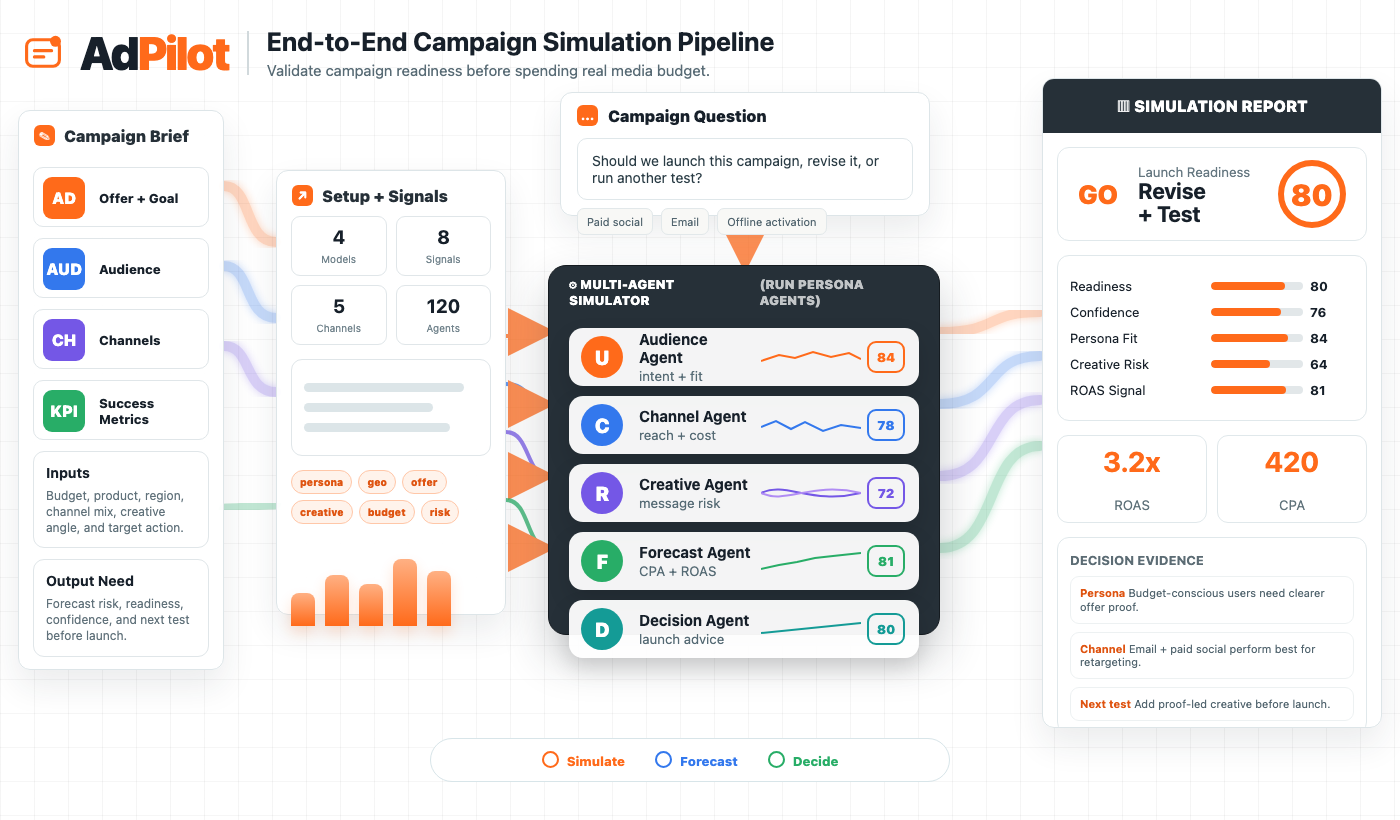
Early campaign decisions are usually made from opinions, channel assumptions, and polished creative ideas. AdPilot turns that uncertainty into a pre-launch simulation: enter the campaign brief, choose model slots, simulate target-user agents, and review forecast metrics, readiness, confidence, persona behavior, and next tests before launch.
User Personas
Maya Patel
Growth Marketer
- Age
- 29
- Context
- Owns paid and organic campaign launches and needs fast pre-launch validation.
- Behavior
- Tests channel mix, offer clarity, audience intent, and campaign risk before launch.
- Pain
- Cannot confidently explain why a campaign is ready without forecast and persona evidence.
Rohan Mehta
Founder / Operator
- Age
- 34
- Context
- Has limited budget and needs a practical read on whether the offer can convert.
- Behavior
- Looks for confidence, readiness, CPA, ROAS, and clear next actions.
- Pain
- Marketing spend feels risky because campaign quality is hard to judge before launch.
Nina Kapoor
Performance Analyst
- Age
- 31
- Context
- Reviews campaign assumptions, metrics, persona groups, and model-generated behavior.
- Behavior
- Compares channels, filters simulated agents, and checks the recommendation logic.
- Pain
- Static campaign plans do not show enough evidence behind expected conversion behavior.
Selected User Persona
Maya Patel, Growth Marketer
Maya is the strongest starting persona because she owns the campaign decision before launch. Her workflow naturally tests AdPilot's full value chain: campaign setup, audience simulation, persona behavior, forecast quality, readiness scoring, and the decision to launch, revise, or run another test.
User Journey Map
| Journey Stage | Actions | Emotion | Pain Points | Opportunities |
|---|---|---|---|---|
| Frame Campaign | Maya enters campaign name, type, objective, audience, geography, budget, duration, offer, creative, and landing page notes. | Focused | The brief is often incomplete and spread across notes, ad platforms, and stakeholder messages. | Turn campaign assumptions into one structured launch input. |
| Choose Simulation | She selects three free-model slots and configures the number of target-user agents. | Curious | It is difficult to know whether one model or one synthetic persona view is reliable enough. | Run multiple model perspectives and enough user agents to expose behavior patterns. |
| Run Agents | AdPilot simulates target users across persona groups such as high-intent evaluators and budget-conscious buyers. | Analytical | Campaign teams usually cannot observe likely user behavior until money is already spent. | Generate pre-launch behavior signals: click, lead, purchase, bounce, retarget, and watch outcomes. |
| Review Report | She checks readiness, confidence, forecast metrics, funnel behavior, persona groups, and next tests. | Cautious | Raw forecast numbers are not enough without the reasons and assumptions behind them. | Show recommendation, model metadata, agent behavior, and assumptions in one decision surface. |
| Decide Launch | Maya uses the result to launch, revise creative, shift budget, or run another experiment. | Confident | Stakeholders need a clear justification for why the campaign should move forward or be changed. | Make the final output a practical launch decision, not only a dashboard. |
Pain Points
Campaign Readiness Is Guesswork
Teams decide whether a campaign is ready based on subjective review, past experience, or stakeholder confidence. They need a structured pre-launch signal before real budget is committed.
Audience Behavior Is Invisible
Campaign briefs describe a target audience, but they rarely show how different user groups might click, ignore, buy, submit a lead, or require retargeting.
Channel Mix Is Hard To Defend
Search, social, email, influencer, LinkedIn, local, event, and offline channels have different strengths. Without comparison, channel decisions become preference-driven.
Forecasts Lack Evidence
Projected impressions, clicks, leads, revenue, CPA, and ROAS are useful only when the assumptions and user behavior behind those numbers are visible.
Creative Risk Appears Too Late
Weak offers, vague creative, broad geography, and poor landing page clarity usually surface after launch. Teams need those risks exposed during planning.
Stakeholder Decisions Are Fragmented
Campaign setup, forecast spreadsheets, creative notes, persona assumptions, and next tests often live in separate tools, making the launch decision slow and unclear.
Pain Point Prioritization
| No. | Pain Point | Time | Effort |
|---|---|---|---|
| 01 | Campaign readiness is guesswork | ||
| 02 | Audience behavior is invisible | ||
| 03 | Channel mix is hard to defend | ||
| 04 | Forecasts lack evidence | ||
| 05 | Creative risk appears too late | ||
| 06 | Stakeholder decisions are fragmented |
Solutions
OK Ideas
Helps teams review launch inputs, but it does not simulate audience behavior or forecast performance.
Useful for planning numbers, but weak at explaining persona behavior, creative risk, and launch readiness.
Improves copy review, but it does not connect creative quality to channels, agents, and campaign outcomes.
Best Ideas
Runs persona-based target users against campaign inputs and outputs behavior signals.
Shows clicks, leads, purchases, confidence, readiness, model metadata, and next tests.
Lets teams inspect individual simulated users, outcomes, channels, and behavior explanations.
Moonshots
End-to-end workspace that turns campaign ideas into simulated user behavior and launch decisions.
Automatically recommends channel budget shifts based on simulated behavior and forecast bands.
Connects pre-launch simulation to live campaign data, learning loops, and post-launch optimization.
Moonshot Prioritization
| No. | Moonshot | Time | Effort |
|---|---|---|---|
| 01 | AdPilot Campaign Simulator | ||
| 02 | Budget optimizer | ||
| 03 | Continuous campaign copilot |
Selected Solution
AdPilot Campaign Simulator
AdPilot Campaign Simulator is the selected solution because it directly connects user value, product feasibility, and measurable campaign decisions. Instead of giving a generic marketing opinion, the system converts campaign inputs into target-user simulations, forecast bands, readiness scoring, and next-test recommendations.
Solution Architecture
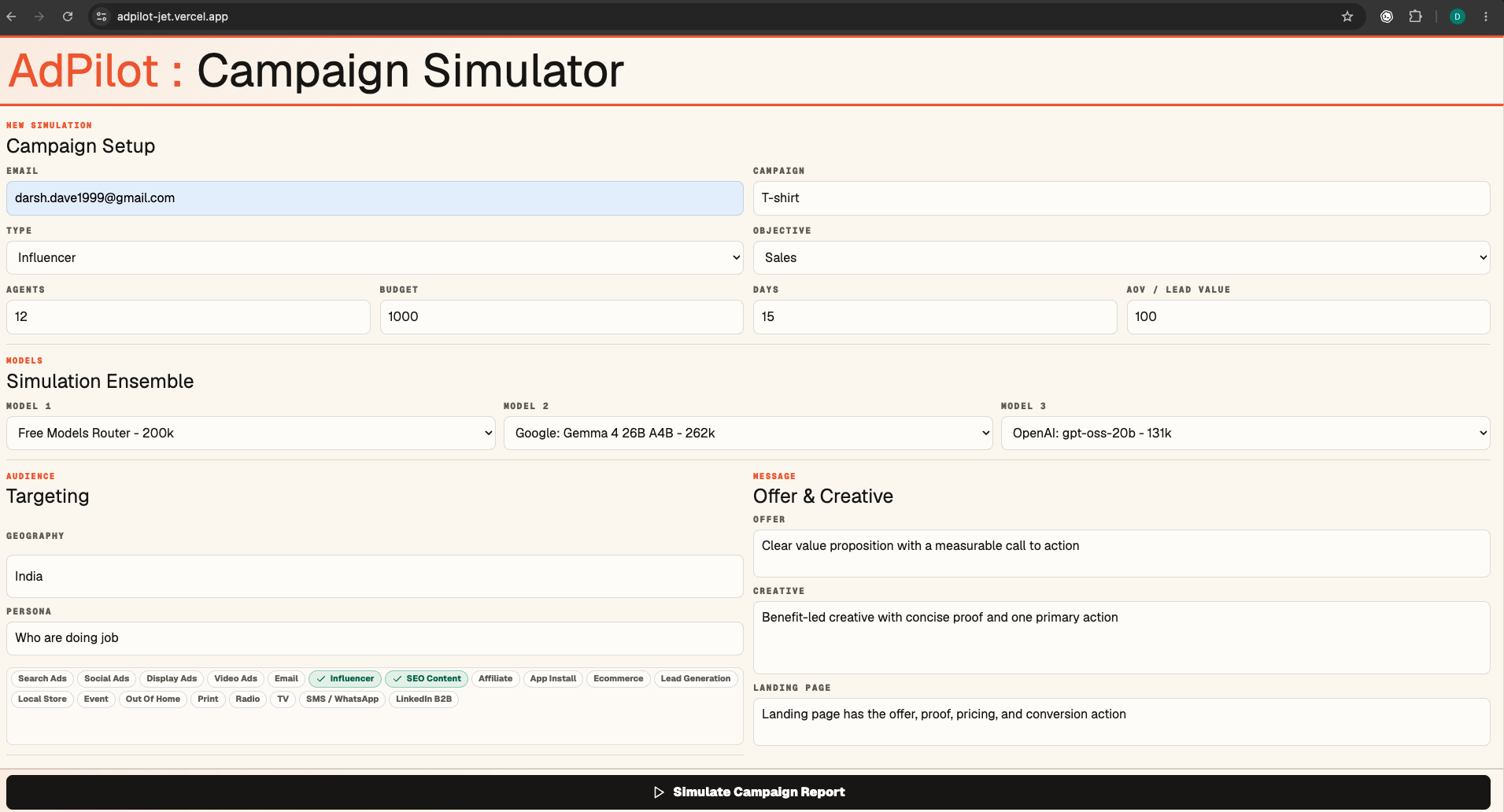
Collect email, campaign type, objective, geography, persona, budget, channels, offer, creative, landing page, AOV, and agent count.
Let the user choose three free OpenRouter model slots while preserving deterministic fallback behavior when no key is configured.
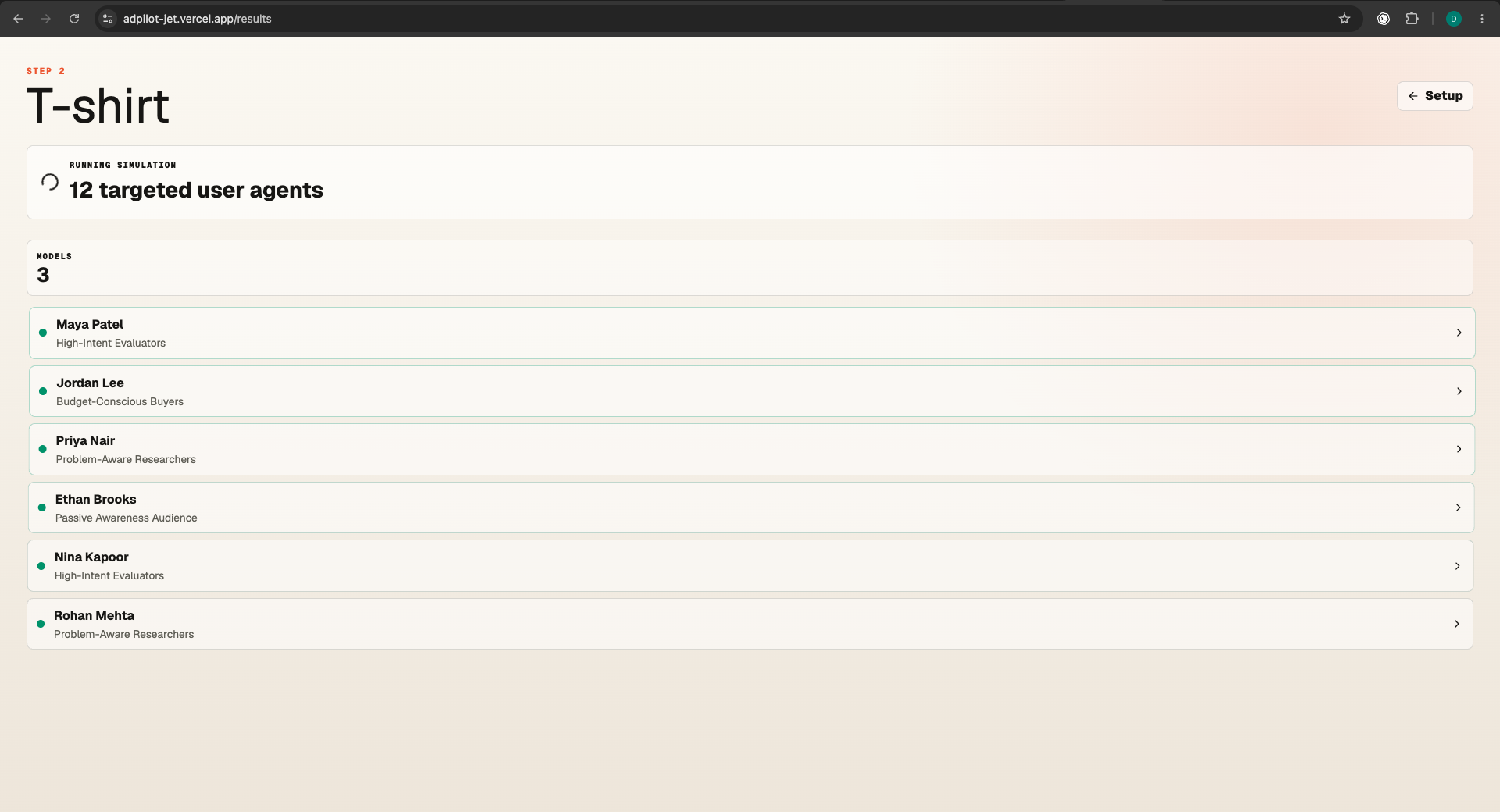
Generate persona groups and simulated outcomes such as click, purchase, lead, bounce, and retarget.
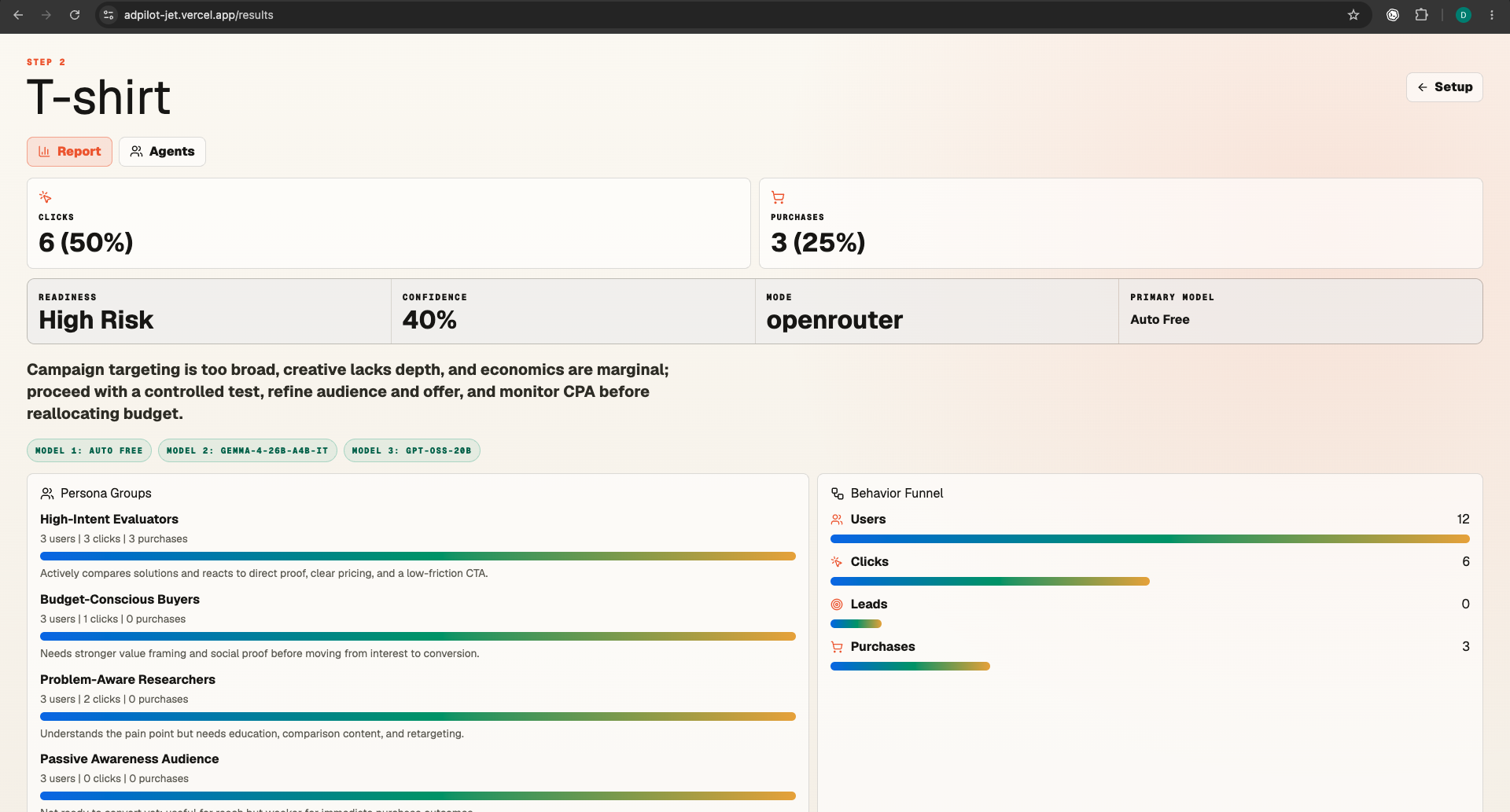
Estimate impressions, reach, clicks, conversions, revenue, CTR, CVR, CPC, CPA, and ROAS through channel benchmarks.
Show readiness, confidence, recommendation summary, active models, funnel metrics, persona groups, and next tests.
Save completed simulations through Supabase-backed endpoints while keeping API keys server-side only.
Prototype Screens
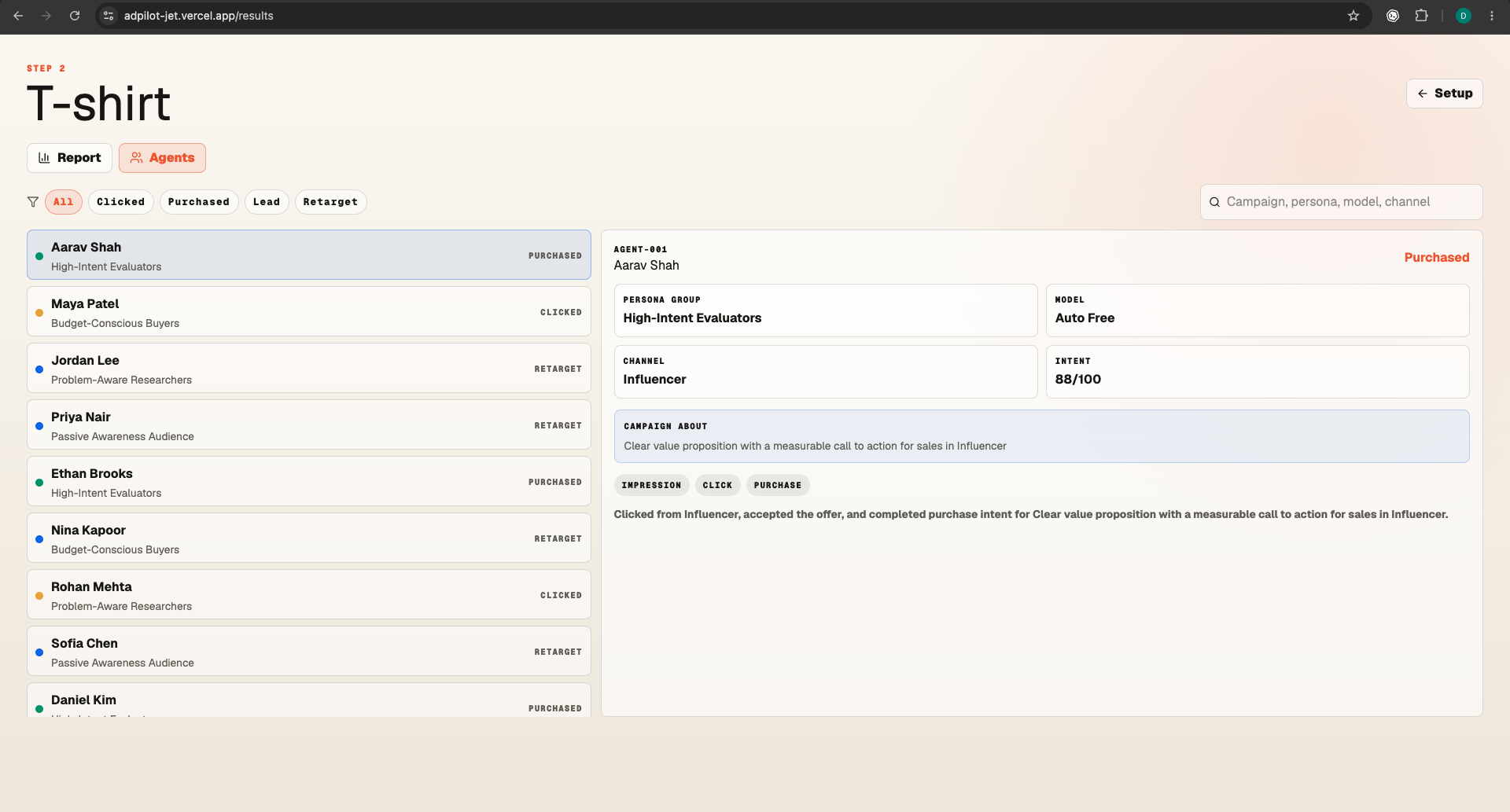
Agent Explorer
Inspect simulated user behavior, not only aggregate metrics.
The agent explorer makes the simulation explainable. Teams can filter agents by clicked, purchased, lead, retarget, or all outcomes, then inspect behavior summaries that explain how a persona reacted to the campaign.
Final Product Direction
AdPilot is a pre-launch campaign validation product. It helps builders and marketers move from subjective campaign confidence to structured evidence: campaign setup, user-agent simulation, forecast metrics, readiness, risk, and next-test decisions.